 (Image source: Gemini)
 We've reached a threshold where innovation means a total shift in how we interact with reality. Think of it like the jump from landline phones to the first iPhone, but this time, the entire world is the interface. You've probably noticed that your devices don't feel like "tools" as much as they feel like extensions of your own intent. This is the hallmark of 2026. We are no longer poking at screens to get things done. We are collaborating with an intelligent ecosystem that understands our context, our goals, and even our physical surroundings. It's a world where the "digital" isn't a place you go, it's a layer that exists everywhere you look.
AI Beyond Generative Models
Remember when everyone was obsessed with AI writing poems or making weird pictures of cats? That feels like ancient history now. In 2026, we've moved into the era of agentic AI. This is a massive shift from those old chatbots that waited for you to type a prompt. Today, AI functions as an autonomous workforce. These agents talk to each other to solve complex problems without you having to micromanage every step.
Imagine you need to organize a business trip. In the old days, you'd spend an hour clicking through sites. Now, your procurement agent talks directly to a supplier agent. They negotiate the price, check your calendar, and book everything based on your preferences. Gartner actually predicted back in 2024 that by 2028, about 90% of B2B buying would be handled this way. We're seeing that happen right now.
We've seen a huge push toward edge computing. This means your AI processing happens right on your device, not on a server thousands of miles away. It's faster, it's more private, and it allows for real-time local processing that feels instantaneous. AI has also become highly specialized. We've moved away from general-purpose models to Domain-Specific Language Models (DSLMs). If you're a doctor or an engineer, you're using an AI trained specifically on your industry's data, making sure of much higher accuracy than the old "one size fits all" models ever could.
Even the way we build these tools has changed. Have you looked at how software is made lately? It's estimated that 55% of all enterprise code is now AI-generated or assisted.² This has sped up innovation, but it's also led to a bit of a reality check. Many companies are actually slowing down their spending to make sure they're getting a real return on investment. They're moving away from the hype and focusing on what actually works for the bottom line.²
Spatial Computing and the VR AR Renaissance
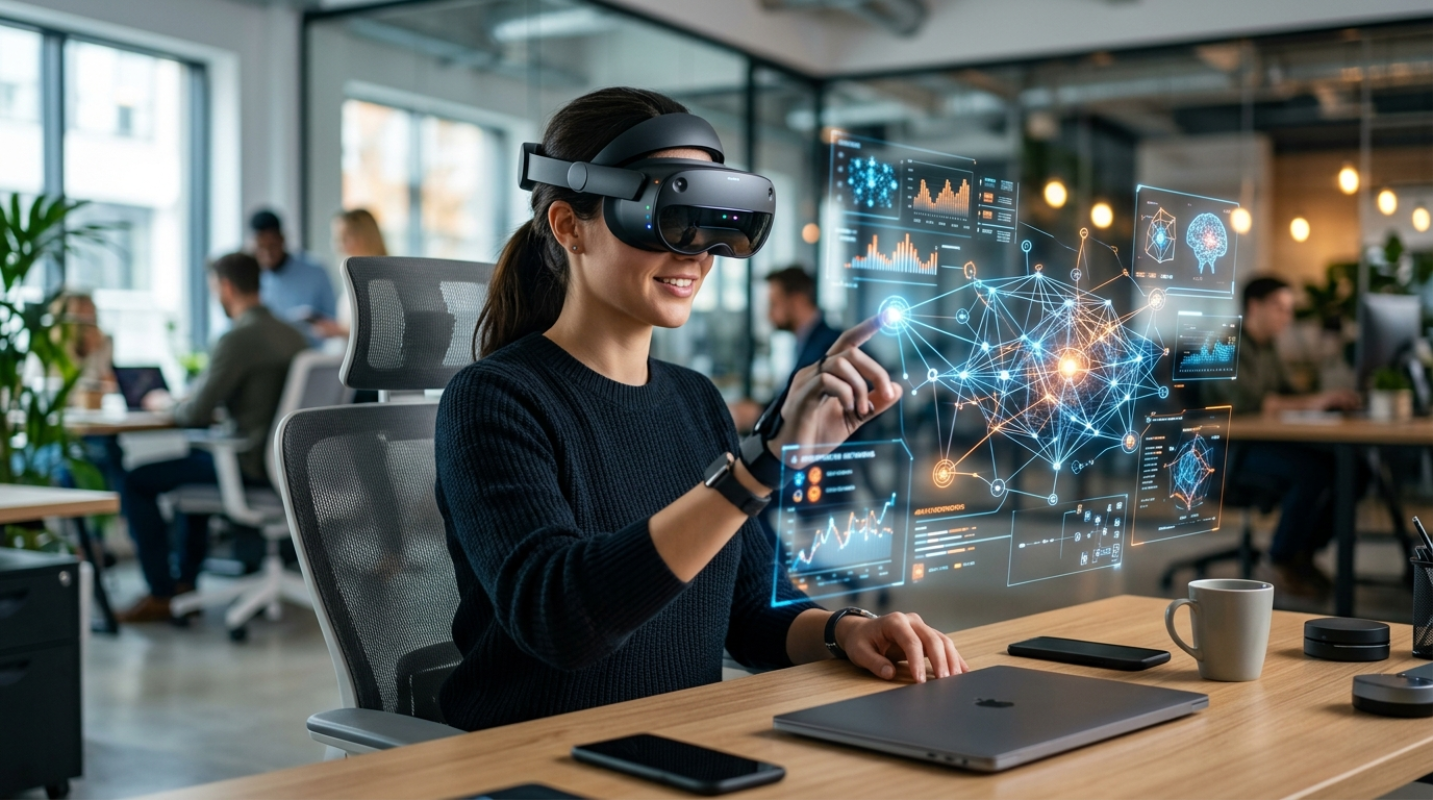
If you haven't put on a headset lately, you're in for a shock. The hardware has matured from clunky plastic goggles into lightweight, sleek optics that you can actually wear for hours. We've moved into the "work-ready" era of spatial computing. It's the digital equivalent of having an infinite office that follows you wherever you go.
The hardware specs in 2026 are honestly mind-blowing. The Apple Vision Pro 2 features displays with 4500 PPI, which is so sharp your eyes can't even distinguish the pixels. Meta has stayed in the game by democratizing the experience with the Quest 5, using Mini-LED tech to make everything look incredibly active. Even Samsung has jumped back in with their Galaxy XR 2, offering a 144Hz refresh rate that finally solved the motion sickness issues that used to plague older VR tech.
Spatial computing has become a standard personal workstation. You can take your entire office, with multiple giant screens, and pin them to the walls of a hotel room or a coffee shop. Over 25% of people now spend at least an hour a day in these virtual environments.
It’s also changing how we learn. Photorealistic training is now the gold standard for high-stakes jobs. If you're a surgeon or a pilot, you're practicing in a virtual world that is indistinguishable from the real thing. Research shows this kind of immersive training can reduce error rates by up to 30%. It's a huge win for safety and efficiency.
Invisible Infrastructure and Ambient Intelligence
The most impressive tech in 2026 is the stuff you can't even see. We've moved toward "ambient intelligence," where your environment responds to you without you ever needing to look at a screen. Think of it like electricity. You don't think about it when you turn on a light. You just expect it to be there. AI is now the invisible force powering our homes and offices.
Ambient sensors are everywhere now. They track movement, light, and even air quality to create smart environments that adjust themselves automatically. Your house knows you're coming home and sets the temperature, adjusts the lighting, and even starts your favorite playlist before you walk through the door. These systems are incredibly good at saving power by only using resources exactly where and when they're needed.
Connectivity is the glue holding this all together. With 6G-ready infrastructure starting to roll out, the latency is so low that your devices feel like they're part of the same brain. This has finally unified the fragmented world of smart home devices. Everything talks to everything else now. Your fridge, your car, and your watch are all on the same page, creating a seamless experience that feels almost magical.
Ethics and Security in an Automated World
With all this power comes some pretty serious questions. How do we stay private in a world that is constantly being monitored by AI? This is one of the biggest challenges we face in 2026. Since AI is always on and always listening to provide that "ambient" experience, the risk of data misuse is higher than ever.
We've seen a massive push for transparency. People are demanding to know how their data is being used and who has access to it. We're also seeing the rise of "human-in-the-loop" systems. This means that for important decisions, like a medical diagnosis or a legal ruling, a human still has the final say. It's a necessary guardrail to prevent the "atrophy of important thinking" that some experts warned about a few years ago.³
There's also a legal side to this. Gartner predicted that by the end of 2026, legal claims related to AI errors would skyrocket. This has made AI governance a core part of every business. You can't just set it and forget it. You have to actively manage the risks. This has also created a new requirement for all of us: AI literacy. If you want to thrive in 2026, you need to understand how these systems work. It's no longer an optional skill. It's a fundamental requirement for the modern world.
Thriving in This New Era
So, how do you handle this fast-moving world? The most important thing is to remember that tech is a tool for help, not a replacement for human intent. The symbiotic relationship between our goals and machine execution is where the real magic happens. You provide the vision, and the AI provides the heavy lifting to make it happen.
Adapting to the pace of change in 2026 can feel a lot, but it's also incredibly exciting. You have more power at your fingertips (and in your glasses, and on your walls) than any generation in human history. The key is to stay curious and keep learning. Don't be afraid to experiment with new tools and find ways to make them work for you.
As we move further into this decade, the distinction between "tech" and "life" will likely disappear entirely. It will just be the way the world works. By embracing these changes now, you're positioning yourself to be a leader in this new reality. The future isn't something that's happening to us. It's something we're building every time we use these incredible new tools to solve a problem or create something new.