 (Image source: Gemini)
 Clutter is the silent killer of productivity. You sit down to work, but instead of focusing on your screen, your eyes drift to the pile of mail, the tangled cables, and the random assortment of pens scattered across your desk. That visual noise creates mental noise, making it nearly impossible to get anything done efficiently. A disorganized space leads to a disorganized mind, but the good news is that you don't need a professional organizer to fix it. We are going to showcase some smart storage solutions that actually work for real people. Let's turn your messy office into a streamlined engine of productivity.
Wall-Mounted Shelving
Most people look at their floor space and think they have run out of room. They forget about the empty walls staring right back at them. Using vertical space is the oldest trick in the book for a reason. It gets items off your desk and into a designated spot that is still within arm's reach.
Floating shelves are clean, modern, and incredibly functional. They attach directly to the wall without visible brackets, giving a sleek appearance that doesn't feel heavy or cluttered. Install two or three rows above your monitor. Use the bottom shelf for things you need daily, like a notebook, and the higher shelves for less-used items like reference books or decorative plants.
- The IKEA LACK series offers simple, affordable floating shelves in various sizes and colors.
- For something more robust, the West Elm Floating Wood Shelves provide a high-end look with solid wood construction.
A metal pegboard behind your desk offers infinite customization. You can add hooks for headphones, small baskets for pens, and clips for important notes. The beauty of a pegboard is its flexibility; you can rearrange the layout in seconds depending on your current project. It turns your wall into a dynamic tool.
- The IKEA SKÅDIS pegboard system is a fan favorite for its versatility and wide range of accessories.
- For a more industrial look, the Wall Control Metal Pegboard is incredibly durable and comes in multiple colors.
Desk Organizers
Your desk surface is prime real estate. Every square inch counts, so you cannot afford to waste it on loose items. Desktop organizers act as the command center for your immediate supplies.
Raising your monitor is good for your neck, but it is also great for storage. Many monitor risers come with built-in drawers or open slots underneath. This creates a "garage" for your keyboard and mouse when you aren't typing, freeing up space for writing or reading.
- The Grovemade Desk Shelf is a premium option that elevates your monitor in style with real wood and a shelf for storage.
- A great budget-friendly alternative is the Amazon Basics Adjustable Wood Monitor Stand, which includes slots for your phone and pens.
Stackable trays allow you to sort documents by urgency. Label the top tray "Inbox" for new items, the middle for "To Do," and the bottom for "File Away." This simple system prevents papers from spreading out horizontally and creates a visual hierarchy of importance.
- The Poppin Letter Tray collection offers stackable, colorful trays that look great on any desk.
- For a more sophisticated feel, the Russell + Hazel Acrylic Trays provide a clear, minimalist look.
The Cable Management Crisis
Nothing ruins the look of a home office faster than a rat's nest of wires. Cables attract dust, make cleaning difficult, and are a safety hazard. Taming them is essential for a clean, functional workspace.
Cable sleeves act like a jacket for your wires, bundling them into a single flexible tube. Combine this with adhesive cable clips on the back edge of your desk. These clips hold your charging cables in place so they don't fall to the floor every time you unplug a device.
- The JOTO Cable Management Sleeve is a popular choice that zips up to conceal multiple cords.
- For holding individual chargers, the OHill Cable Clips are small, adhesive holders that stick to your desk or nightstand.
An under-desk cable tray is a wire basket that screws or clamps onto the underside of your desk. You can place your power strip and all the bulky power bricks inside this basket, keeping everything off the floor and out of sight.
- The Uplift Desk Under-Desk Cable Management Tray is a sturdy, well-designed option.
- A more affordable and simple solution is the IKEA SIGNUM, which is a metal mesh tray that gets the job done effectively.
Filing Cabinets
We live in a digital world, but paper still exists. Tax documents, contracts, and medical records need a physical home. A good filing cabinet protects these important papers from getting lost or damaged.
Mobile pedestals are small filing cabinets on wheels that usually fit perfectly under a standard desk. Look for one with a mix of drawer sizes—a shallow top drawer for pens and a deep bottom drawer for hanging files.
- The Poppin Slim Stow 3-Drawer File Cabinet is a sleek, modern option available in many colors.
- For a more traditional office look, the HON 3-Drawer File Cabinet is a durable and reliable choice.
Lateral cabinets are wider than they are deep, holding more files and doubling as a printer stand or console table. The top surface is perfect for a printer, a lamp, or organizing bins, allowing it to serve a dual purpose.
- The Bush Business Furniture Series C Lateral File Cabinet offers a professional look and ample storage.
- For a mid-century modern aesthetic, the West Elm Mid-Century Lateral File is a stylish piece of furniture.
Rolling Carts
Flexibility is key in a home office, especially if your space is small. Rolling carts allow you to bring your supplies to you and then push them away when you are done.
These metal carts are ubiquitous for a reason. They offer three levels of open storage that are easy to access. Use the top tier for daily essentials, the middle for project files, and the bottom for extra supplies like printer paper. At the end of the day, you can roll the cart into a corner.
- The original IKEA RÅSKOG is the classic choice.
- A similar and widely available option is the 3-Tier Metal Utility Cart from The Container Store, which comes in various colors.
Plastic or metal drawer carts offer more concealed storage, which is excellent for organizing small, loose items like craft supplies or tech accessories. Label each drawer clearly so you can find what you need without searching.
- The IRIS USA 6-Drawer Rolling Storage Cart is a lightweight, plastic cart with multi-colored drawers perfect for sorting.
- For a more robust solution, the Bisley 8-Drawer Steel Cabinet is a high-quality, long-lasting option.
Hidden Storage
Sometimes the best storage is the kind you can't see. Multifunctional furniture helps you maximize space without making the room look like a warehouse.
Storage Ottomans
A storage ottoman can serve as a footrest, a guest seat, and a storage bin. Lift the lid, and you have a perfect spot for bulky items like blankets, extra cables, or old notebooks.
- The Threshold Round Storage Ottoman from Target is a stylish and affordable choice.
- For more space, the Simpli Home Avalon Storage Ottoman Bench can sit under a window and hold a large volume of items.
Bookshelves with Doors
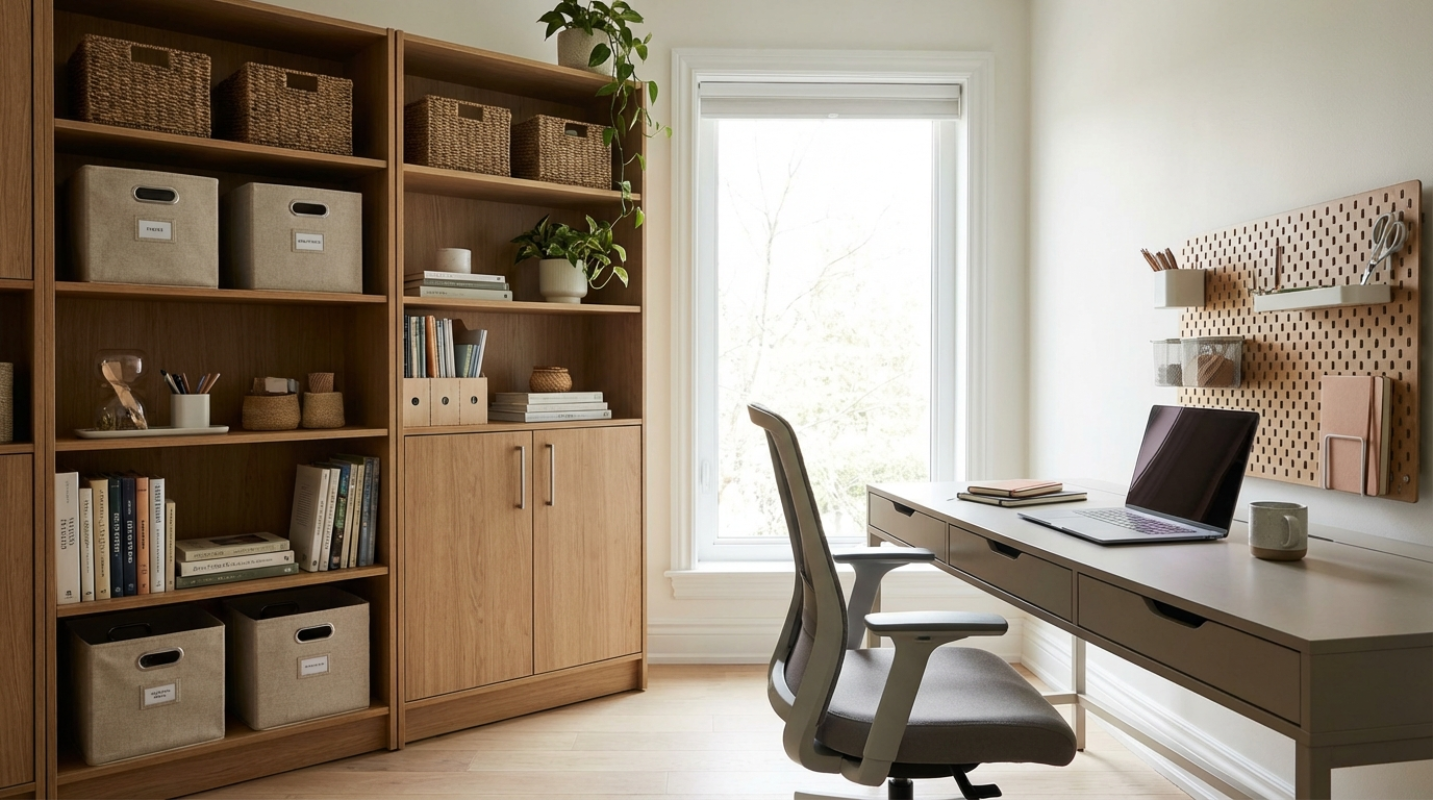
A bookshelf with cabinet doors on the bottom half offers the best of both worlds. Display your nice books and photos on the open top shelves, and hide your ugly binders and stacks of paper behind the closed doors below.
- The IKEA BILLY / OXBERG bookcase combination is a customizable and classic solution.
- The Crate & Barrel Tate Bookcase Cabinet offers a more high-end, design-forward look.
Drawer Dividers
Without dividers, every drawer becomes a junk drawer within a week. Adjustable plastic or bamboo dividers let you section off a drawer to fit exactly what you own. You can create a long slot for rulers and a small square slot for paperclips. When you open the drawer, you see everything at a glance.
- The OXO Good Grips Expandable Drawer Dividers are spring-loaded and grip the drawer securely.
- Bambüsi Bamboo Drawer Dividers are an eco-friendly and adjustable alternative.
Digital Storage
The best way to organize paper is to get rid of it. Reducing the physical stuff you have to store makes all other storage solutions more effective.
Scanners and Shredders
A reliable scanner is a powerful storage tool. Scan receipts and notes immediately, save them to the cloud, and then feed the physical copy into a shredder. This drastically reduces the need for filing cabinets.
- For scanning, the Fujitsu ScanSnap iX1600 is a fast, double-sided document scanner.
- For shredding, the Amazon Basics 8-Sheet Cross-Cut Shredder is a great, affordable option for home office use.