 (Image source: Gemini)
 Feeling sluggish at 2 PM? It might not be your lunch. Discover how CO2, VOCs, and poor air quality sabotage your focus and how to fix it. Ever feel like your brain is swimming in molasses by 2 PM? You’ve got the high-speed internet, the ergonomic chair, and a fresh pot of coffee, yet you’re staring at the same paragraph for the fifth time. It’s easy to blame a lack of sleep or that heavy lunch, but the real culprit might be the very air you’re breathing. Indoor Air Quality (IAQ) is often treated as a background concern, something for building managers or HVAC technicians to worry about. But if you work from home or spend your day in a modern office, the air around you is the primary fuel for your cognitive engine. When that fuel is contaminated with high levels of carbon dioxide or microscopic dust, your mental gears start to grind.
So what does this actually mean for your daily output? It’s simple. If you want to maintain high levels of focus and make better decisions, you have to treat your air quality as a professional tool.
The Big Three Pollutants Sabotaging Your Focus
There are three main invisible enemies lurking in your workspace that actively drain your brainpower. These are cognitive disruptors.
Carbon Dioxide (CO2)
We exhale CO2 with every breath, and in a sealed room, it builds up faster than you’d think. Recent data highlights the "21% rule," which suggests that for every 400 ppm (parts per million) increase in CO2, cognitive scores decline significantly.
- The Impact: At 1,000 ppm, you are operating at a disadvantage. At 2,500 ppm, common in crowded meeting rooms, your decision-making abilities plummet.
- The Symptom: Slower response times and difficulty processing complex information.
Volatile Organic Compounds (VOCs)
These are gases emitted by common office items like furniture, carpets, and even cleaning supplies. You might get used to the smell of a new desk or floor cleaner, but your brain does not adapt to the chemical impact.
- The Impact: Studies show that people in low-VOC environments score 101 percent higher on cognitive tests than those in conventional offices.
- The Benefit: Lowering VOCs leads to massive improvements in high-level tasks like crisis response and strategy.
Particulate Matter (PM2.5)
These are tiny particles, less than 2.5 micrometers in diameter. They are small enough to travel deep into your lungs and enter your bloodstream.
- The Impact: There is no "safe" lower limit. Even small increases in PM2.5 can slow down your reaction times.
- The Consequence: A constant, invisible drag on your alertness and physical health.
Ventilation
The most effective way to drop those CO2 levels is through ventilation. You need a high air exchange rate to move the old, stale air out and bring fresh, oxygen-rich air in.
- Strategic Window Use: If you have windows, open them early in the morning when pollen and pollution are lower. Create a cross-breeze by opening windows on opposite sides of the room to flush air out quickly.
- Heat Recovery Ventilators (HRVs): For modern homes, HRVs are brilliant. They swap stale indoor air for fresh outdoor air while retaining the temperature, so you don't lose heat in the winter or cool air in the summer.
- Demand-Controlled Ventilation: Smart offices use sensors to detect occupancy. If a room gets crowded and CO2 rises, the system automatically ramps up airflow. You can mimic this at home by using a CO2 monitor to signal when it's time to open a door.
Filtration
Ventilation brings air in, but filtration ensures that air is clean. Basic furnace filters often miss the most harmful particles, so upgrading your filtration game is essential.
- MERV 13 Filters: Upgrade your central HVAC filter to at least MERV 13. These are dense enough to capture fine particulates and some viruses without straining your system.
- HEPA Filters: For the gold standard, use HEPA filters. They capture 99.97 percent of particles, including the PM2.5 bits that ruin your focus.
- Clean Air Delivery Rate (CADR): When buying a portable purifier, look at the CADR. You want a machine powerful enough to cycle the air in your room at least five times per hour.
- Maintenance: Set a recurring reminder to check filters every three months. A dirty filter can become a source of pollution itself if mold starts to grow on the trapped dust.
Humidity and Temperature
It’s hard to focus when your skin feels itchy or you are shivering. Humidity and temperature aren't just about comfort; they are about maintaining a baseline of physical ease so your brain can stay on task.
The ideal range for humidity in your workspace is between 30% and 50%. If humidity drops too low, the air becomes dry, which can irritate your respiratory system and make you more susceptible to viruses. On the other hand, if humidity climbs too high, the air feels heavy and there is an increased risk of mold growth and a general sense of lethargy. Temperature control also plays a critical role—extreme cold or heat forces your body to expend energy trying to regulate itself, leaving you with less energy for mental tasks. Keeping your workspace at a steady, comfortable temperature helps preserve that energy for sharper focus and productivity.
Top Recommendations for Your Workspace
Investing in your environment is an investment in your career. You don't need a complete renovation to see results.
- IAQ Monitors: Buy a device that tracks CO2, VOCs, and PM2.5 in real-time. Seeing the numbers change is the best way to learn about your specific environment.
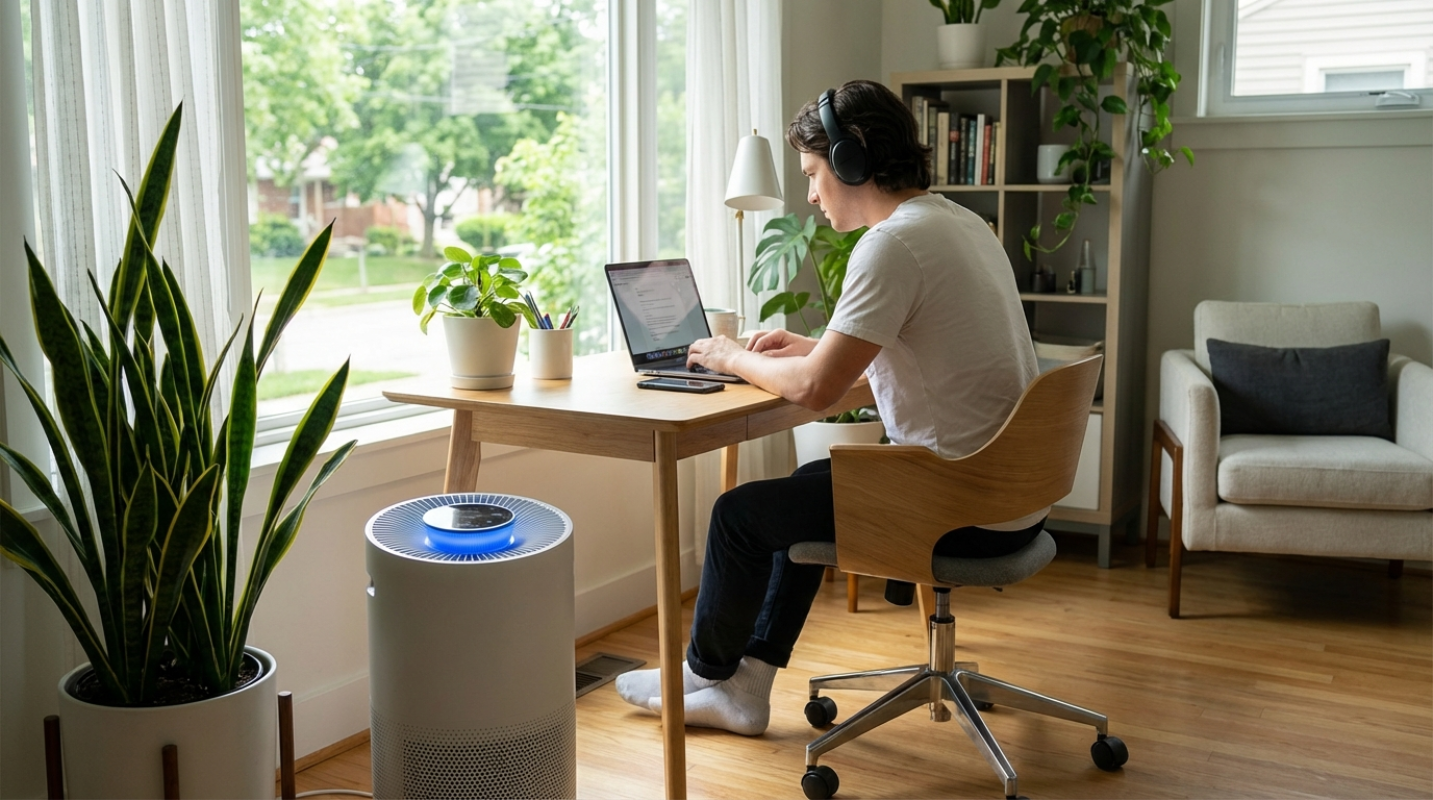
- Portable HEPA Purifiers: Perfect for home offices where you can't control the central air. Place one near your desk to create a "clean air bubble."
- Low-Emission Supplies: When restocking, choose cleaners and furniture certified as low-VOC to reduce chemical off-gassing.
Making Air Quality a Priority
Improving your indoor air doesn't have to be a massive, expensive project. It starts with awareness. Once you realize that a spike in CO2 is the reason you’re feeling drowsy, you can take immediate action.
Start small. Buy a monitor. Open a window during your lunch break. Swap out your old air filter. These might seem like minor changes, but the cumulative effect on your productivity is massive. When you aren't fighting against your environment, you have more mental bandwidth for the work that actually matters.
Think of air quality as a non-negotiable part of your professional setup. You wouldn't work on a broken laptop with a flickering screen, so why work in a room full of stale, polluted air? Your brain deserves better fuel. Treat your air with the same respect you treat your time, and you’ll likely find that those afternoon slumps become a thing of the past.
This is for informational and educational purposes only. Readers are encouraged to consult qualified professionals and verify details with official sources before making decisions. This content does not constitute professional advice.